Mars
The Red Planet with blue sunsets. Mars has giant volcanoes, a canyon as long as the US is wide and sunsets that glow blue. Explore its rusty dust, ancient rivers and rovers.
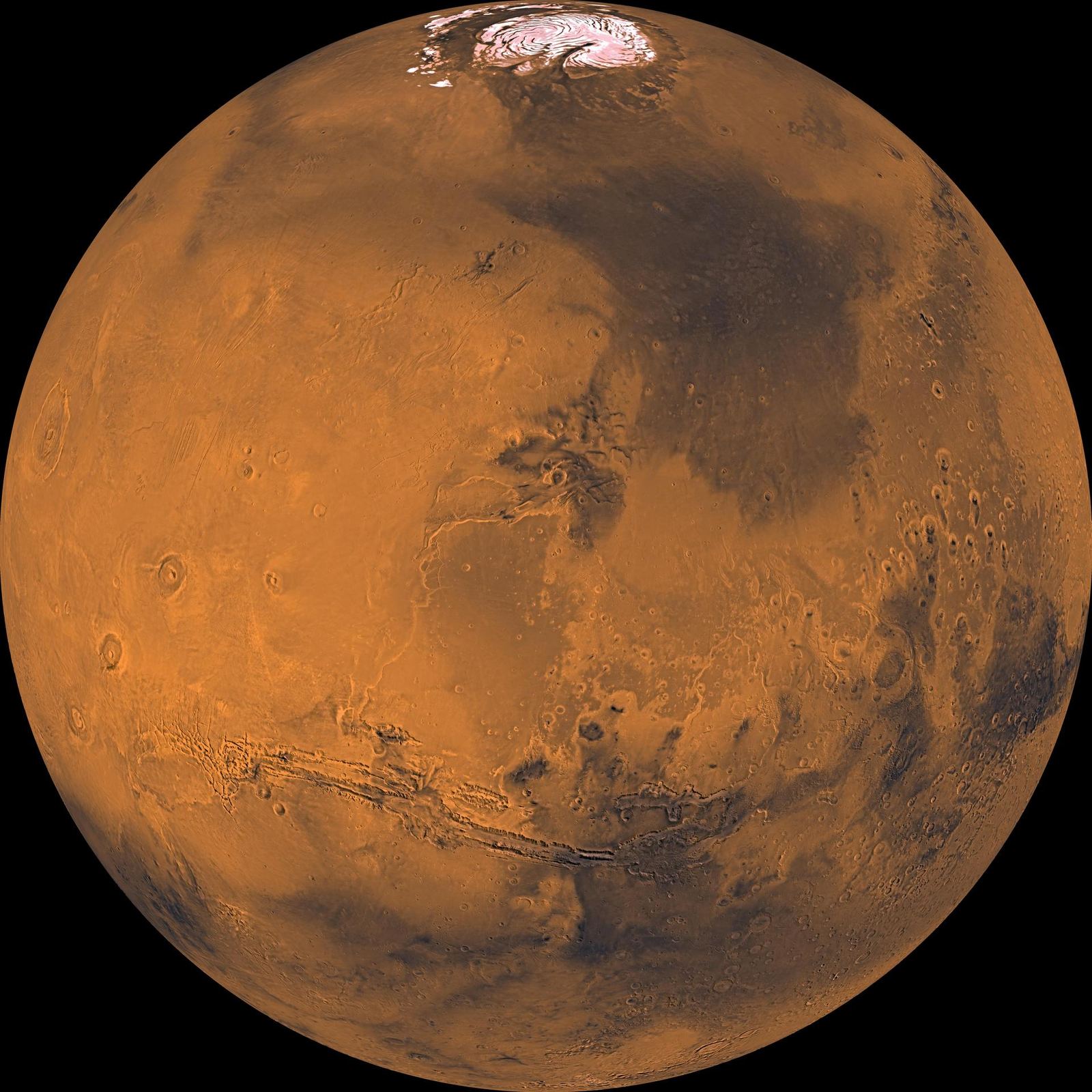
Global color views of Mars from Viking data: NASA/JPL/USGS, Public domain
A rusty desert world
Mars gets its famous red color from iron oxide, essentially rust, in its dust and rocks. Standing on the surface, you would see a butterscotch sky, rocky plains and distant hills under a Sun that looks smaller and dimmer than at home. You would also be freezing: the average temperature is around -60 °C, and the air is so thin, mostly carbon dioxide, that you could not survive without a pressurized suit.
A Martian day, called a sol, is only about 40 minutes longer than ours, but a year lasts 687 Earth days. Mars also has seasons, polar ice caps and dust storms that can occasionally grow to wrap the whole planet.
Video: Perseverance Rover's Descent and Touchdown on Mars: Onboard Camera Views. Credit: NASA/JPL-Caltech (source). NASA media; no endorsement implied.
Sunsets on Mars are blue
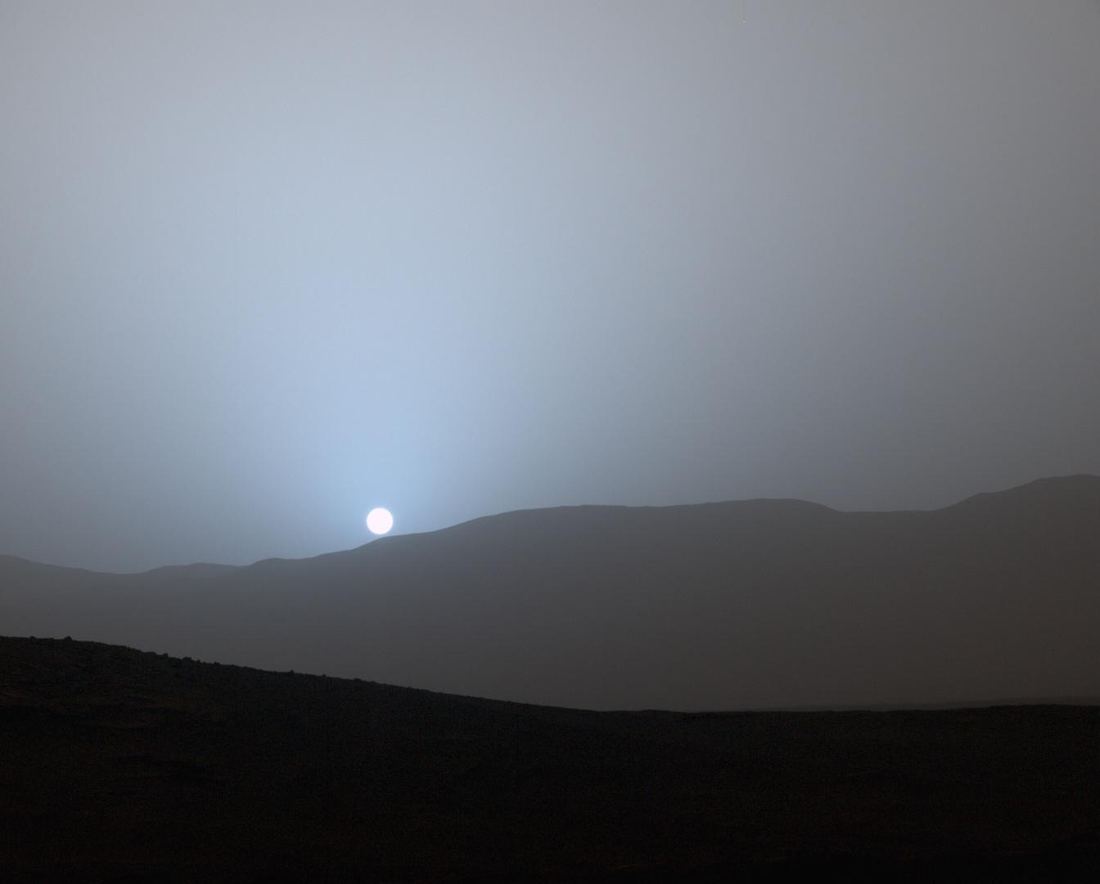
Fine Martian dust scatters blue light forward near the Sun, so sunsets on Mars look blue, as photographed by NASA's Spirit and Curiosity rovers.
YouTube @Planetinio (launching soon). Photos in this Short: Carbon dioxide clouds over Mont Mercou, Curiosity Sol 3063 (53100058892).jpg - semeion.photo Credit: NASA/JPL-Caltech/MSSS/Simeon Schmauß (CC BY 2.0) via Wikimedia Commons | Martian-Sunset-O-de-Goursac-Curiosity-2013.jpg - NASA/JPL/MSSS; processings and mosaic: Olivier de Goursac (f (CC BY-SA 3.0) via Wikimedia Commons | Iridescent clouds over Gale Crater (enhanced color) (54302292059).jpg - semeion.photo (Public domain) via Wikimedia Commons | MarsSunset.jpg - NASA/JPL/Texas A&M/Cornell (Public
Blue sunsets on the Red Planet
On Earth, sunsets glow orange and red. On Mars, it is the other way around. Fine dust in the Martian air scatters blue light forward, close to the direction of the Sun, so as the Sun sinks low a cool blue halo forms around it while the rest of the sky stays dusty and tan.
NASA's Curiosity rover captured this effect in color in 2015 from Gale Crater, and it remains one of the most striking reminders that Mars is an alien world, even when its landscapes look familiar.
Giant volcanoes and dried-up rivers
Mars is home to Olympus Mons, the largest volcano known in the solar system, rising about 22 km, roughly two and a half times the height of Mount Everest. Nearby, the Valles Marineris canyon system stretches nearly 4,000 km, about the distance from California to New York.
Orbiters and rovers have found dry riverbeds, ancient lake deltas and minerals that only form in water. Billions of years ago, Mars was warmer and wetter, with a thicker atmosphere. When it lost most of its magnetic field, the solar wind gradually stripped much of that air away, and the planet dried and cooled.
Mars also has two tiny, lumpy moons, Phobos and Deimos, which may be captured asteroids or debris from an ancient impact. Phobos orbits so low that it circles Mars about three times a day and is slowly spiraling inward. In tens of millions of years it will likely break apart or crash into the planet.
A planet run by robots
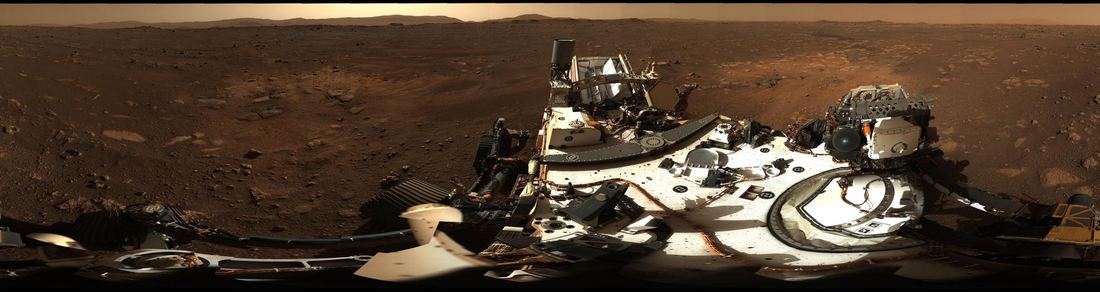
No planet besides Earth has been explored as thoroughly. Viking 1 sent the first long-lived images from the surface in 1976, followed by rovers such as Sojourner, Spirit, Opportunity and Curiosity. NASA's Perseverance rover landed in Jezero Crater in February 2021 and is collecting rock samples from an ancient river delta, searching for signs of past microbial life.
It carried a passenger, too: the Ingenuity helicopter, which made the first powered, controlled flight on another planet in April 2021 and went on to fly dozens of times.
Facts on this page were checked against these sources.
- Global color views of Mars from Viking data: NASA/JPL/USGS, Public domain
- A blue sunset in Gale Crater, seen by Curiosity: NASA/JPL-Caltech/MSSS/Texas A&M Univ., Public domain
- Perseverance's first 360-degree panorama: NASA/JPL-Caltech/MSSS/ASU, Public domain
- Video: Perseverance Rover's Descent and Touchdown on Mars: Onboard Camera Views, NASA/JPL-Caltech, NASA (public domain)
- Short photos: Carbon dioxide clouds over Mont Mercou, Curiosity Sol 3063 (53100058892).jpg - semeion.photo Credit: NASA/JPL-Caltech/MSSS/Simeon Schmauß (CC BY 2.0) via Wikimedia Commons | Martian-Sunset-O-de-Goursac-Curiosity-2013.jpg - NASA/JPL/MSSS; processings and mosaic: Olivier de Goursac (f (CC BY-SA 3.0) via Wikimedia Commons | Iridescent clouds over Gale Crater (enhanced color) (54302292059).jpg - semeion.photo (Public domain) via Wikimedia Commons | MarsSunset.jpg - NASA/JPL/Texas A&M/Cornell (Public domain) via Wikimedia Commons | MarsSunsetCut.jpg - NASA (Public domain) via Wikimedia Commons | MarsSunset losslesscropgam1p2.jpg - NASA's Mars Exploration Rover (Public domain) via Wikimedia Commons | Curiosity rover first selfie at Rocknest Sol 85 (53095922486).jpg - semeion.photo (CC BY 2.0) via Wikimedia Commons | Curiosity rover selfie at Mont Mercou Sol 3070 (53677088587).jpg - semeion.photo (Public domain) via Wikimedia Commons
Text written by Planetinio.