
Jupiter
King of the planets. Jupiter is more than twice as massive as all other planets combined, with a storm wider than Earth. Explore its moons, stripes and missions.
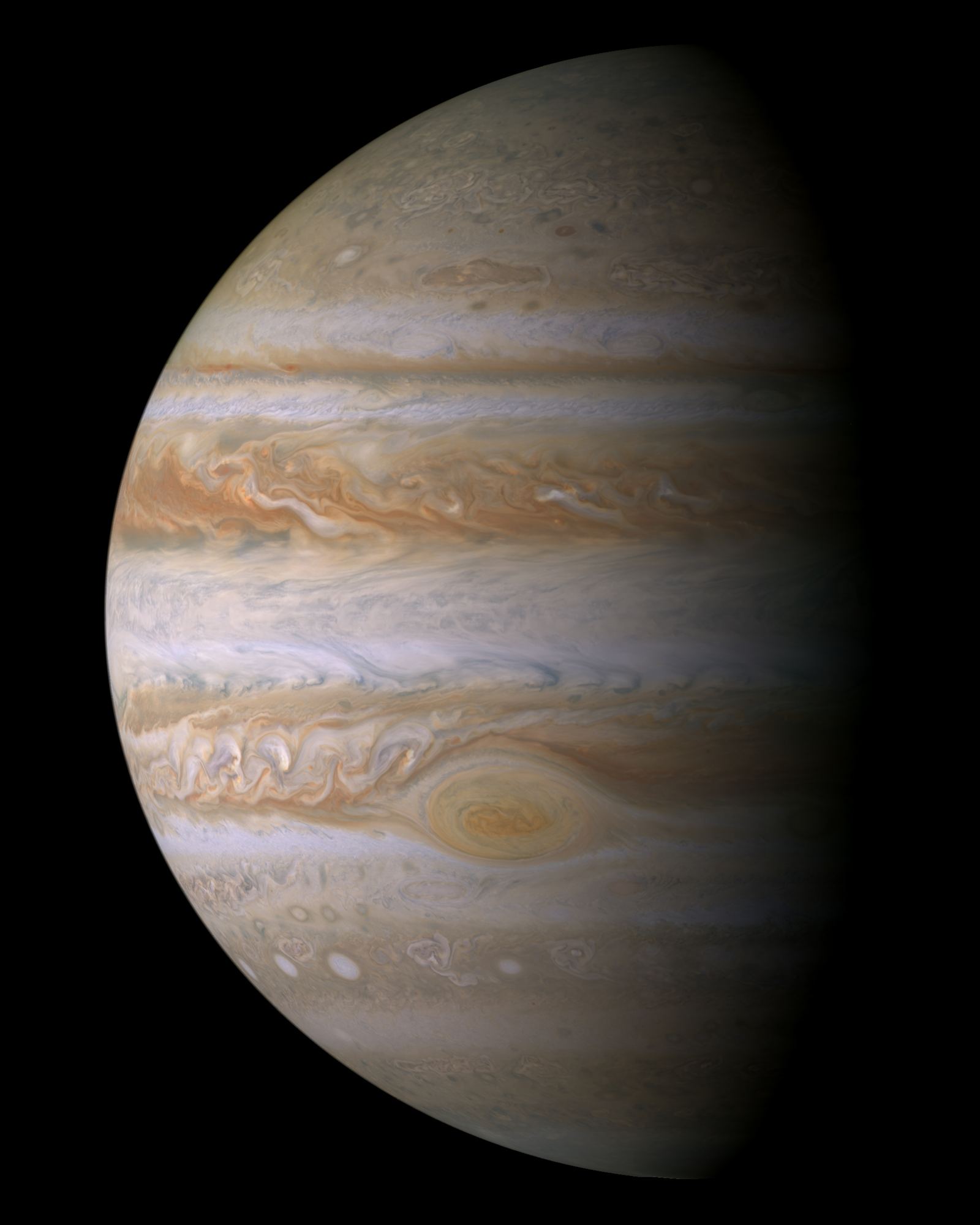
Jupiter portrait from the Cassini spacecraft: NASA/JPL/Space Science Institute, Public domain
A giant made of gas
Jupiter is so big that more than 1,300 Earths could fit inside it, and it holds more than twice the mass of all the other planets combined. Like the Sun, it is made mostly of hydrogen and helium. There is no solid ground to stand on: dive into its clouds and the gas would just get thicker and hotter until, deep inside, hydrogen is squeezed into a strange liquid that behaves like a metal.
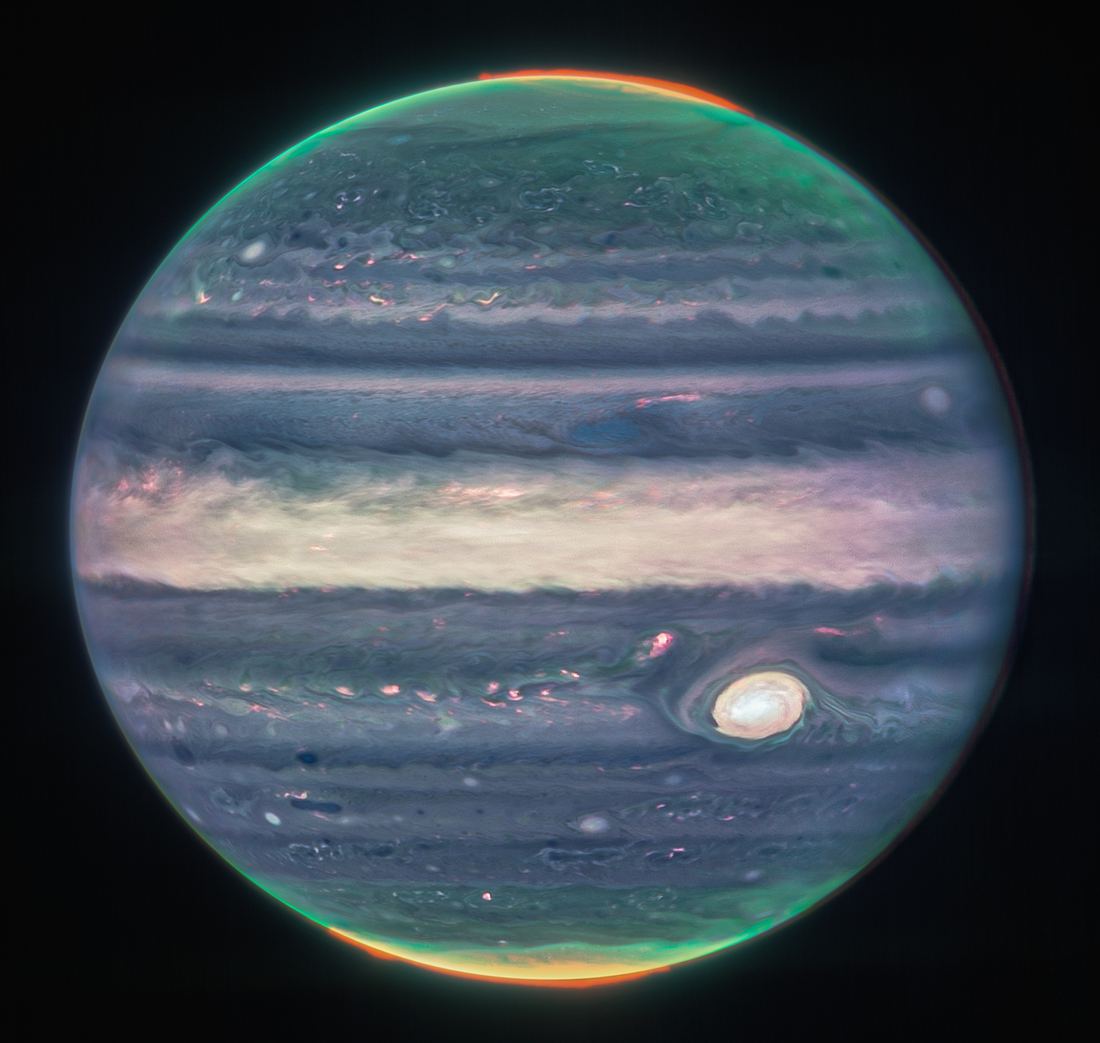
That metallic hydrogen generates the strongest planetary magnetic field in the solar system, and Jupiter's poles glow with auroras far more powerful than Earth's.
Jupiter's clouds are colored by ammonia, water and other compounds whose exact chemistry is still debated. From Earth, it is one of the brightest objects in the night sky, and even a small backyard telescope will show its stripes and its four largest moons lined up like tiny stars.
Video: Hubble's Brand New Image of Jupiter. Credit: NASA's Goddard Space Flight Center (source). NASA media; no endorsement implied.
Stripes, storms and the Great Red Spot
Jupiter spins faster than any other planet, completing a day in under ten hours. That rapid rotation stretches its clouds into colorful bands of rising and sinking gas, with jet streams racing between them.
Its most famous feature, the Great Red Spot, is a giant storm that has been watched for at least 150 years and possibly much longer. It is wider than Earth, though it has been shrinking over the past century, and Hubble keeps tracking how its shape and color change from year to year.
A miniature solar system of moons
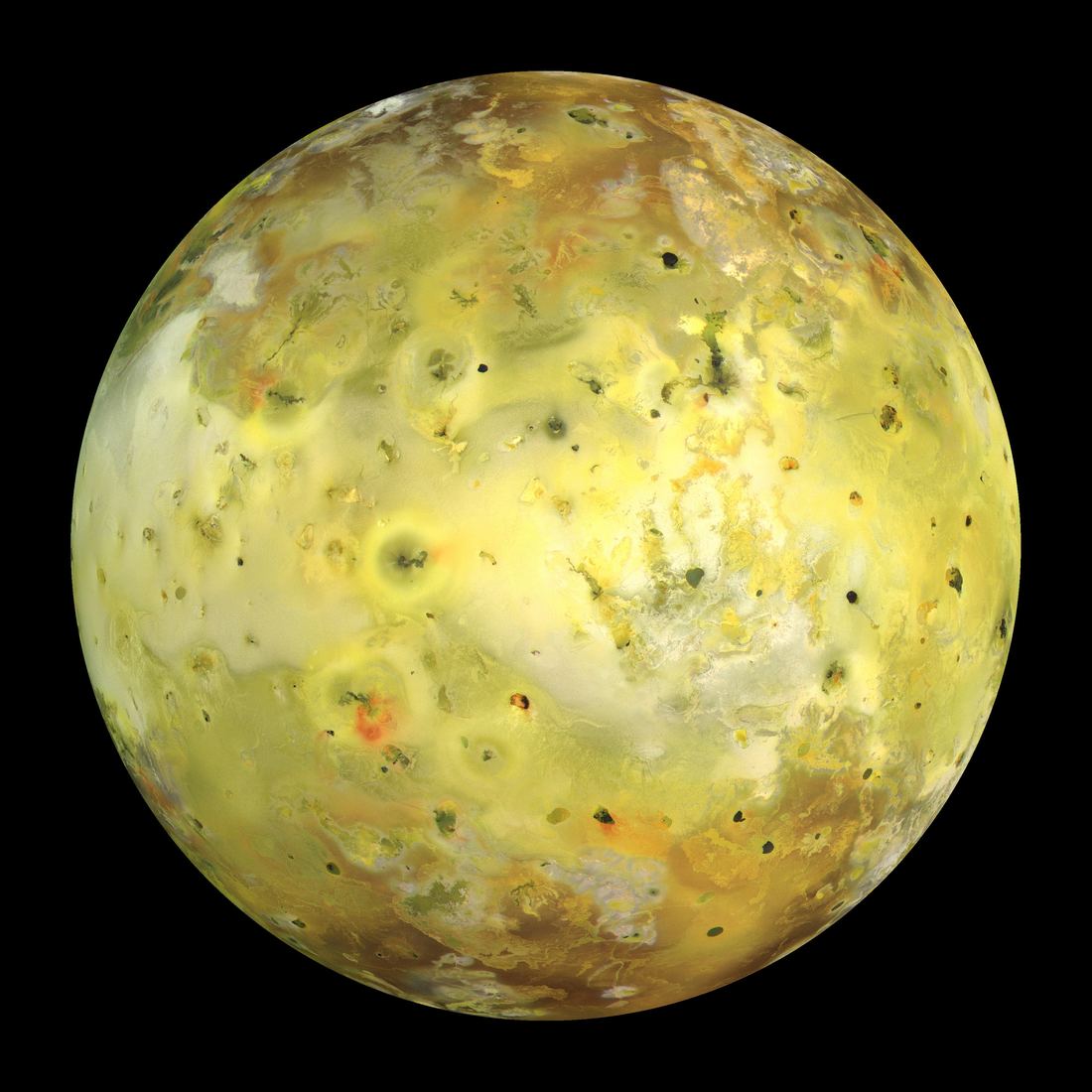
Jupiter has 115 confirmed moons, and the four largest were spotted by Galileo Galilei in 1610. Io is the most volcanic world known, covered in active volcanoes powered by tidal squeezing from Jupiter's gravity. Europa hides a global saltwater ocean beneath its icy shell, making it one of the best places to look for life beyond Earth. Ganymede is the largest moon in the solar system, even bigger than Mercury, and Callisto is one of the most heavily cratered objects we know.
Jupiter's huge gravity also shaped the rest of the solar system, steering asteroids and comets and possibly influencing where the rocky planets formed.
Missions to the giant
Pioneer 10 made the first flyby in 1973, and the Voyager probes revealed Io's volcanoes and Jupiter's faint rings in 1979. NASA's Galileo orbited from 1995 to 2003 and dropped a probe into the atmosphere. Since 2016, NASA's Juno spacecraft has swooped low over the poles, finding enormous clusters of cyclones and mapping the planet's interior.
Two new missions are on the way: NASA's Europa Clipper, launched in 2024 and due to arrive in 2030, and the European Space Agency's JUICE, which will study Ganymede, Callisto and Europa.
- NASA Science: Jupiter Facts
- NASA Science: Jupiter Moons
- Phys.org: Close Juno flyby unlocks sharp new image of Jupiter moon Thebe
Facts on this page were checked against these sources.
- Jupiter portrait from the Cassini spacecraft: NASA/JPL/Space Science Institute, Public domain
- Jupiter in infrared from the James Webb Space Telescope: NASA's James Webb Space Telescope. Image processing by Judy Schmidt., Public domain
- Io, Jupiter's volcanic moon, from Galileo: NASA/JPL/University of Arizona, Public domain
- Video: Hubble's Brand New Image of Jupiter, NASA's Goddard Space Flight Center, NASA (public domain)
Text written by Planetinio.



.jpg)
