Saturn
The jewel of the solar system. Saturn's dazzling rings are made of ice and rock, and the planet is less dense than water. Explore its rings, moons and the Cassini mission.
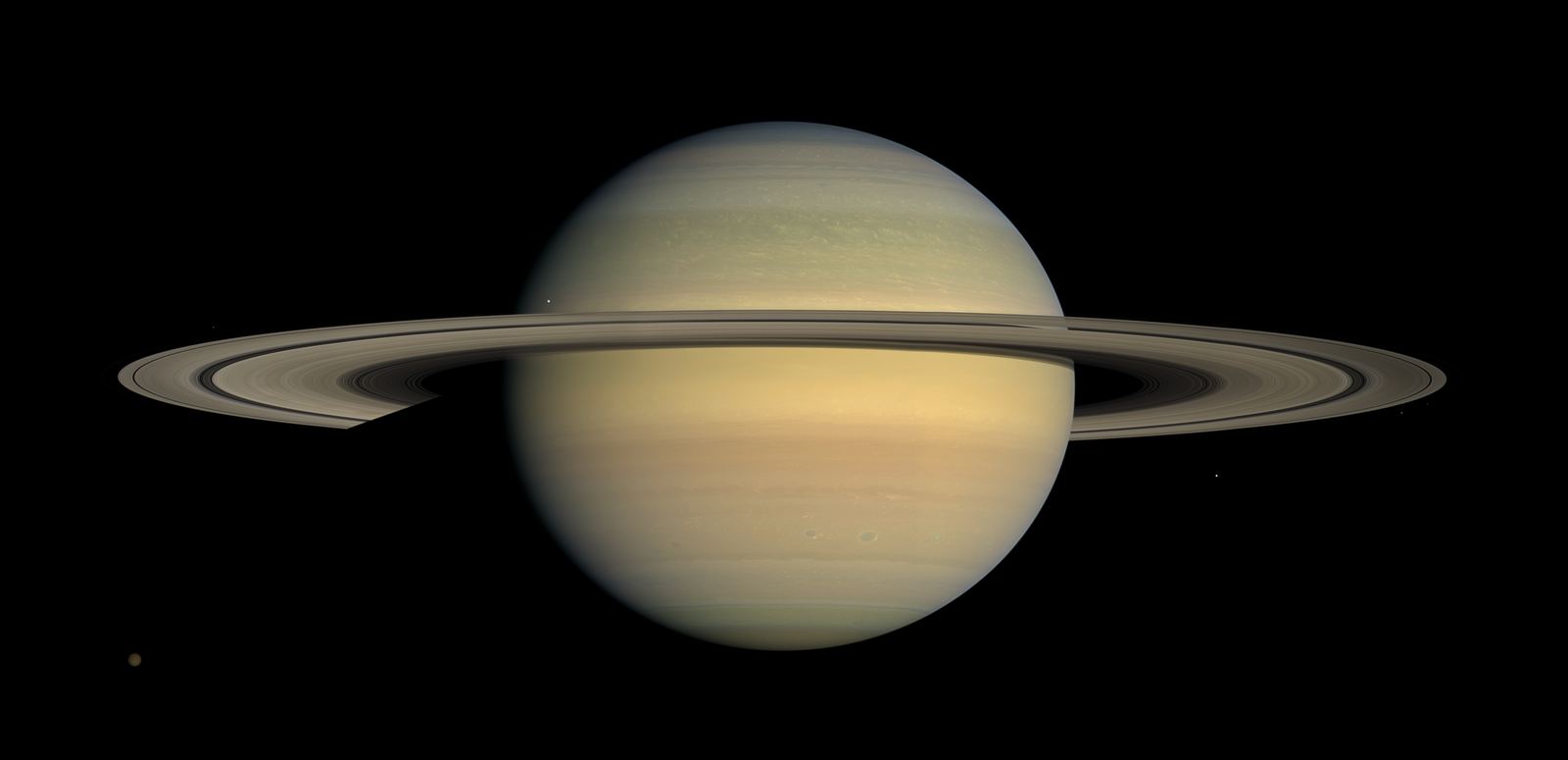
Saturn during equinox, seen by Cassini: NASA/JPL/Space Science Institute, Public domain
Rings of ice
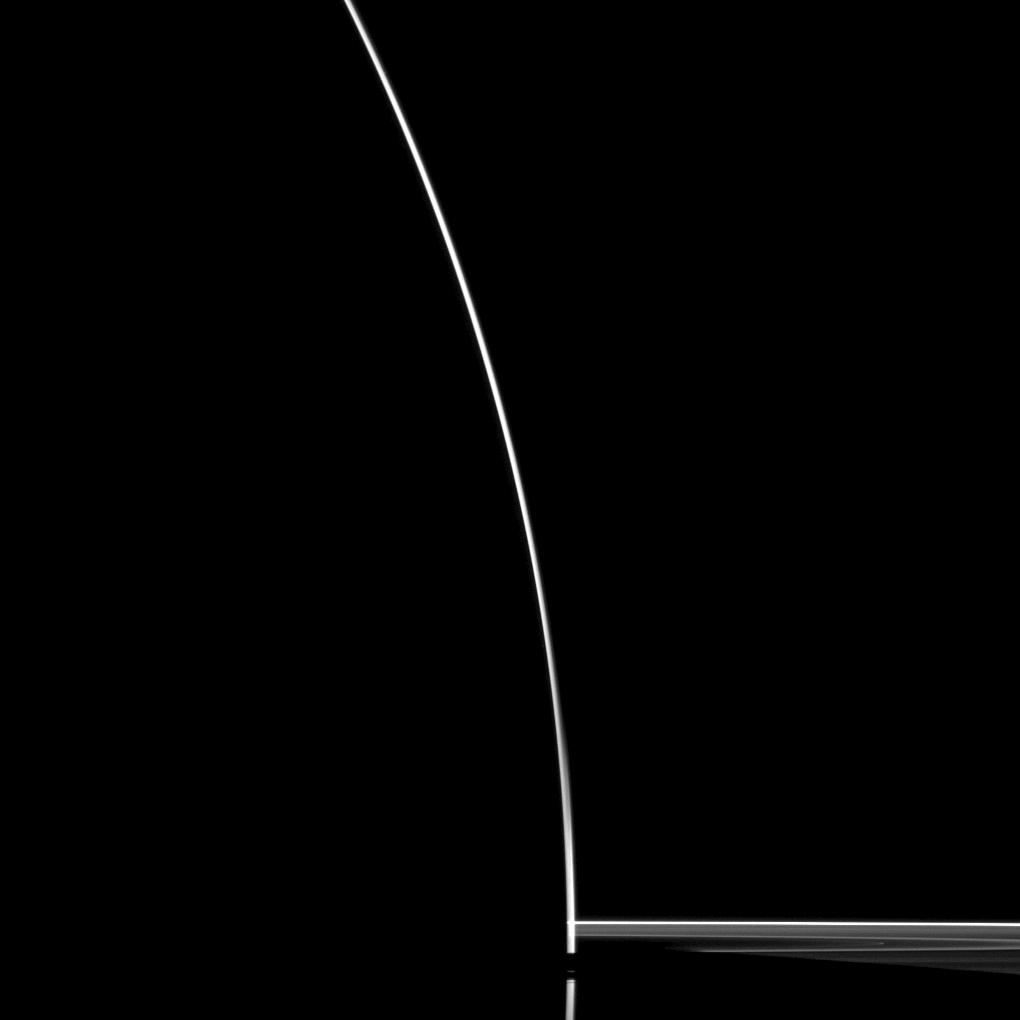
Saturn's rings are the most spectacular in the solar system. They stretch about 280,000 km across, wide enough to span most of the distance between Earth and the Moon, yet in most places they are only around 10 meters thick. Seen edge-on, they almost vanish.
The rings are made of countless pieces of water ice, mixed with a little rock and dust, ranging from tiny grains to chunks as big as a house. Small moons orbit within and beside them, sculpting sharp edges, gaps and wave patterns like shepherds herding a flock.
Saturn's rings were first seen by Galileo in 1610, but his small telescope could not make sense of them. His sketches made the planet look as if it had handles or ears. It took decades and better telescopes before astronomer Christiaan Huygens worked out that Saturn was surrounded by a thin, flat ring that does not touch the planet.
Video: Saturn's Rings Are Disappearing. Credit: NASA's Goddard Space Flight Center (source). NASA media; no endorsement implied.
A planet that would float
Saturn is the second largest planet, but it is mostly hydrogen and helium and has the lowest density of any planet, lower than water. If you could find a bathtub big enough, Saturn would float.
It spins quickly, completing a day in about ten and a half hours, which makes it visibly squashed at the poles. Its winds are fierce, and at its north pole sits a bizarre six-sided jet stream, a hexagon wider than Earth that has persisted for decades.
Rings that are raining away
Here is a surprising twist: Saturn is slowly losing its rings. Icy particles are pulled into the planet by gravity and its magnetic field, falling as a kind of ring rain. Scientists estimate the rings could largely disappear over roughly the next few hundred million years.
That has fueled a lively debate about their age. Measurements from the Cassini spacecraft suggest the rings may be much younger than Saturn itself, though some researchers argue they could still be ancient. Either way, we happen to live at a good time to see them.
Cassini and a moon with an ocean
Pioneer 11 and the two Voyagers flew past Saturn between 1979 and 1981. Then NASA's Cassini spacecraft orbited the planet from 2004 to 2017, carrying the European Huygens probe, which parachuted onto the moon Titan in 2005. Titan has a thick atmosphere and lakes of liquid methane and ethane. NASA's Dragonfly rotorcraft is being built to fly through its skies.
Cassini also discovered geysers of water vapor and ice spraying from the small moon Enceladus, fed by a hidden ocean. In 2017, low on fuel, Cassini dove into Saturn's atmosphere in a planned Grand Finale.
Titan, Saturn's largest moon, is bigger than the planet Mercury. It is the only moon in the solar system with a thick atmosphere, and it is the only place besides Earth known to have stable liquid on its surface, where methane rain falls from orange skies into rivers, lakes and seas.
Facts on this page were checked against these sources.
- Saturn during equinox, seen by Cassini: NASA/JPL/Space Science Institute, Public domain
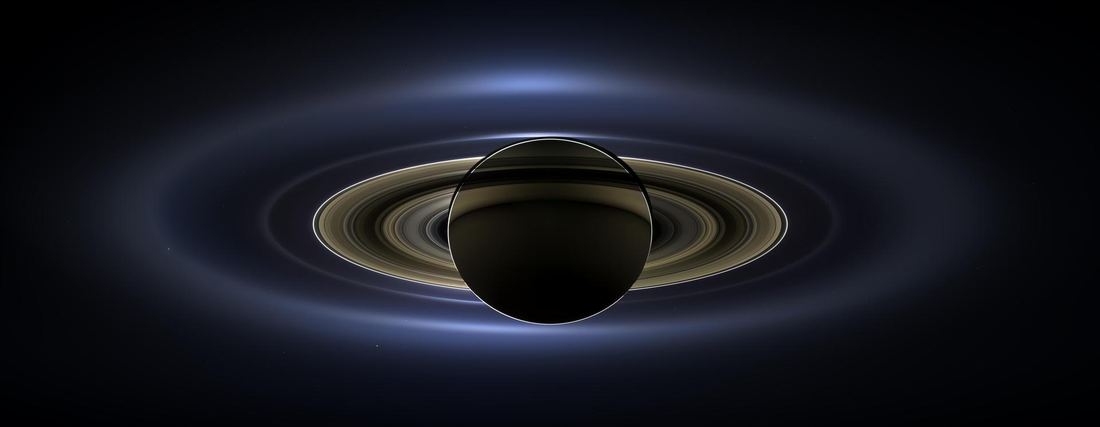
- The Day the Earth Smiled, July 19, 2013: NASA/JPL-Caltech/SSI, Public domain
- Saturn in silhouette from Cassini: NASA/JPL/Space Science Institute, Public domain
- Video: Saturn's Rings Are Disappearing, NASA's Goddard Space Flight Center, NASA (public domain)
Text written by Planetinio.