
Neptune
The windiest planet in the solar system. Neptune has the fastest winds of any planet, topping 2,000 km/h, plus dark storms and a backward moon. Explore the farthest planet.
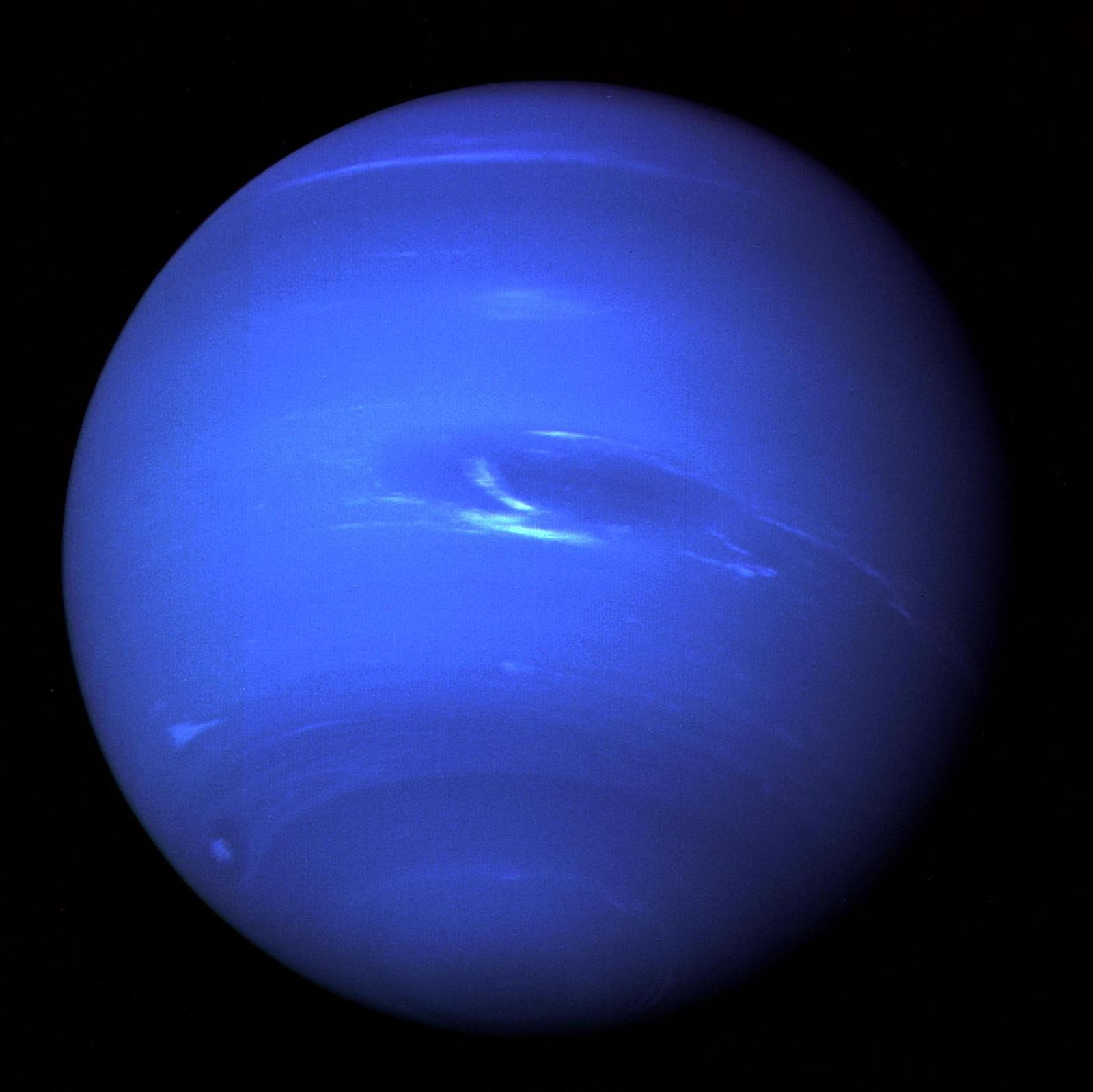
Neptune and its Great Dark Spot from Voyager 2: NASA/JPL, Public domain
The fastest winds in the solar system
Neptune is the most distant planet, receiving only a tiny fraction of the sunlight Earth gets, yet its weather is the most violent we know. Winds in its upper atmosphere blow at more than 2,000 km/h, faster than the speed of sound on Earth and stronger than any hurricane on our planet.
Scientists are still working out how such a cold, dim world can drive winds this powerful. Part of the answer is that Neptune gives off more than twice as much heat as it receives from the Sun, and with no solid surface to create friction, the winds can build to extreme speeds.
Video: Hubble Watches Neptune's Dark Storm Die (time-lapse). Credit: NASA's Goddard Space Flight Center; Hubble images NASA/ESA (source). NASA media; no endorsement implied.
Neptune has the fastest winds in the solar system
Voyager 2 measured winds above 2,000 km/h on Neptune, the fastest in the solar system. Neptune takes about 165 years to orbit the Sun and completed its first orbit since its 1846 discovery in 2011.
YouTube @Planetinio (launching soon). Photos in this Short: Neptune Full.jpg - NASA (Public domain) via Wikimedia Commons | Neptune - Voyager 2 (29347980845) flatten crop.jpg - NASA / JPL / Voyager-ISS / Aster Cowart (Public domain) via Wikimedia Commons | Great Dark Spot (cropped).jpg - NASA (Public domain) via Wikimedia Commons | PIA00048 Great Dark Spot and Scooter (cropped).jpg - NASA/JPL (Public domain) via Wikimedia Commons | PIA00063 Neptune - True Color of Clouds.jpg - NASA/JPL (Public domain) via Wikimedia Commons | Neptune - Voyager 2 (29347980
Storms that come and go
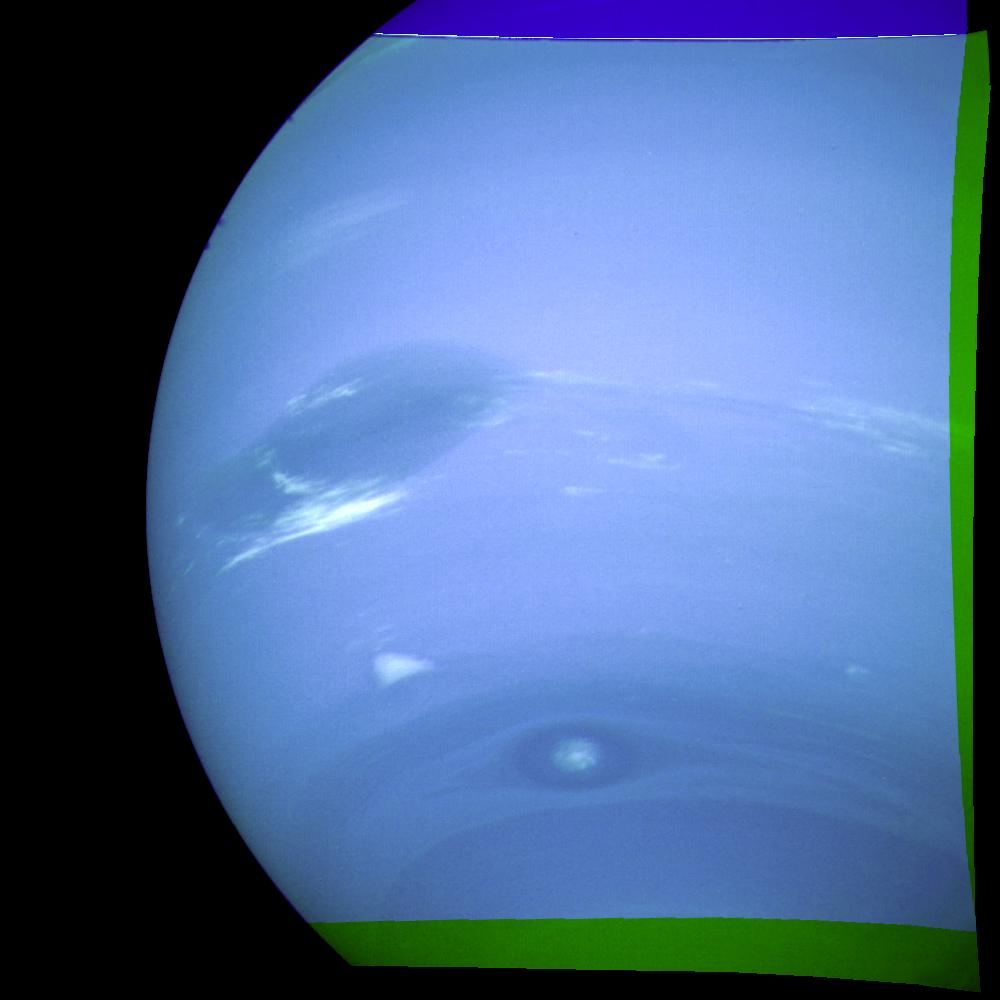
When Voyager 2 flew past in 1989, it spotted a giant storm about the size of Earth, nicknamed the Great Dark Spot, along with bright white clouds of methane ice racing around the planet. A few years later, Hubble looked again and the Great Dark Spot had vanished.
Since then Hubble has watched several new dark storms form and fade, showing that Neptune's weather is surprisingly changeable. Its deep blue color comes from methane gas absorbing red light, plus a haze that is thinner than the one on Uranus.
Found with mathematics
Neptune is the only planet discovered by prediction rather than by chance. In the 1840s, astronomers noticed that Uranus was drifting from its expected path, as if something unseen was tugging on it. Urbain Le Verrier calculated where that mystery planet should be, and on September 23, 1846, Johann Galle found Neptune within about a degree of the predicted spot.
Neptune takes about 165 Earth years to orbit the Sun, so it completed its first full orbit since discovery only in 2011.
Neptune is the eighth and farthest planet from the Sun, about 30 times farther out than Earth. At that distance, sunlight takes roughly four hours to arrive, and from Neptune's cloud tops the Sun would look like an extremely bright star rather than a disk. It cannot be seen with the naked eye from Earth.
Triton, the backward moon
Neptune has 16 known moons, but one dominates. Triton orbits in the opposite direction to Neptune's spin, a strong sign that it was once a dwarf planet from the Kuiper Belt that Neptune captured. Voyager 2 saw dark plumes rising from its frozen nitrogen surface, making it one of the coldest active worlds known.
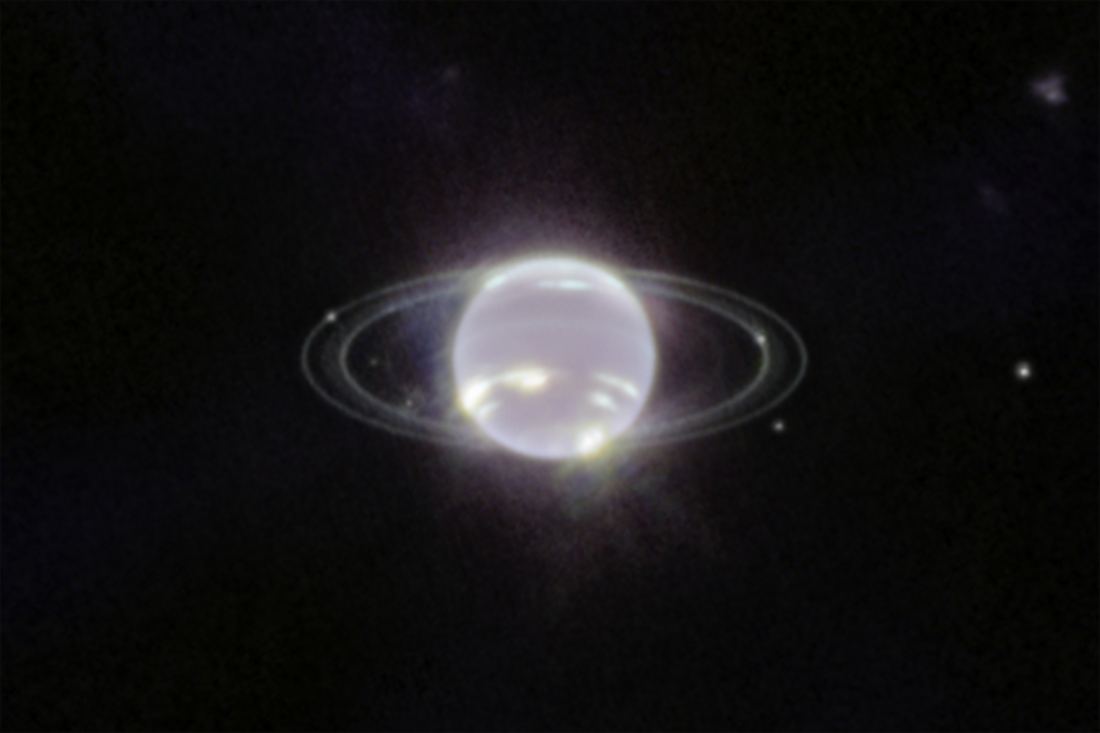
Neptune also has faint, clumpy rings. Voyager 2 remains the only spacecraft to visit, and today the James Webb Space Telescope shows those rings more clearly than at any time since that 1989 flyby.
Facts on this page were checked against these sources.
- Neptune and its Great Dark Spot from Voyager 2: NASA/JPL, Public domain
- Neptune and its rings from the James Webb Space Telescope: NASA, ESA, CSA, STScI; image processing by Joseph DePasquale (STScI), Public domain
- Neptune's Great Dark Spot, Scooter and Dark Spot 2: NASA/JPL, Public domain
- Video: Hubble Watches Neptune's Dark Storm Die (time-lapse), NASA's Goddard Space Flight Center; Hubble images NASA/ESA, NASA (public domain)
- Short photos: Neptune Full.jpg - NASA (Public domain) via Wikimedia Commons | Neptune - Voyager 2 (29347980845) flatten crop.jpg - NASA / JPL / Voyager-ISS / Aster Cowart (Public domain) via Wikimedia Commons | Great Dark Spot (cropped).jpg - NASA (Public domain) via Wikimedia Commons | PIA00048 Great Dark Spot and Scooter (cropped).jpg - NASA/JPL (Public domain) via Wikimedia Commons | PIA00063 Neptune - True Color of Clouds.jpg - NASA/JPL (Public domain) via Wikimedia Commons | Neptune - Voyager 2 (29347980845) half crop.jpg - NASA / JPL / Voyager-ISS / Justin Cowart (Public domain) via Wikimedia Commons | Springtime on Neptune- Increased Brightness Shows Seasonal Change.jpg - NASA Hubble (CC BY 2.0) via Wikimedia Commons | Neptune Full.jpg - NASA (Public domain) via Wikimedia Commons
Text written by Planetinio.



.jpg)