Pluto
The dwarf planet with a heart. Pluto, the dwarf planet of the Kuiper Belt, has a heart-shaped nitrogen glacier, ice mountains and blue skies. Relive New Horizons' visit.
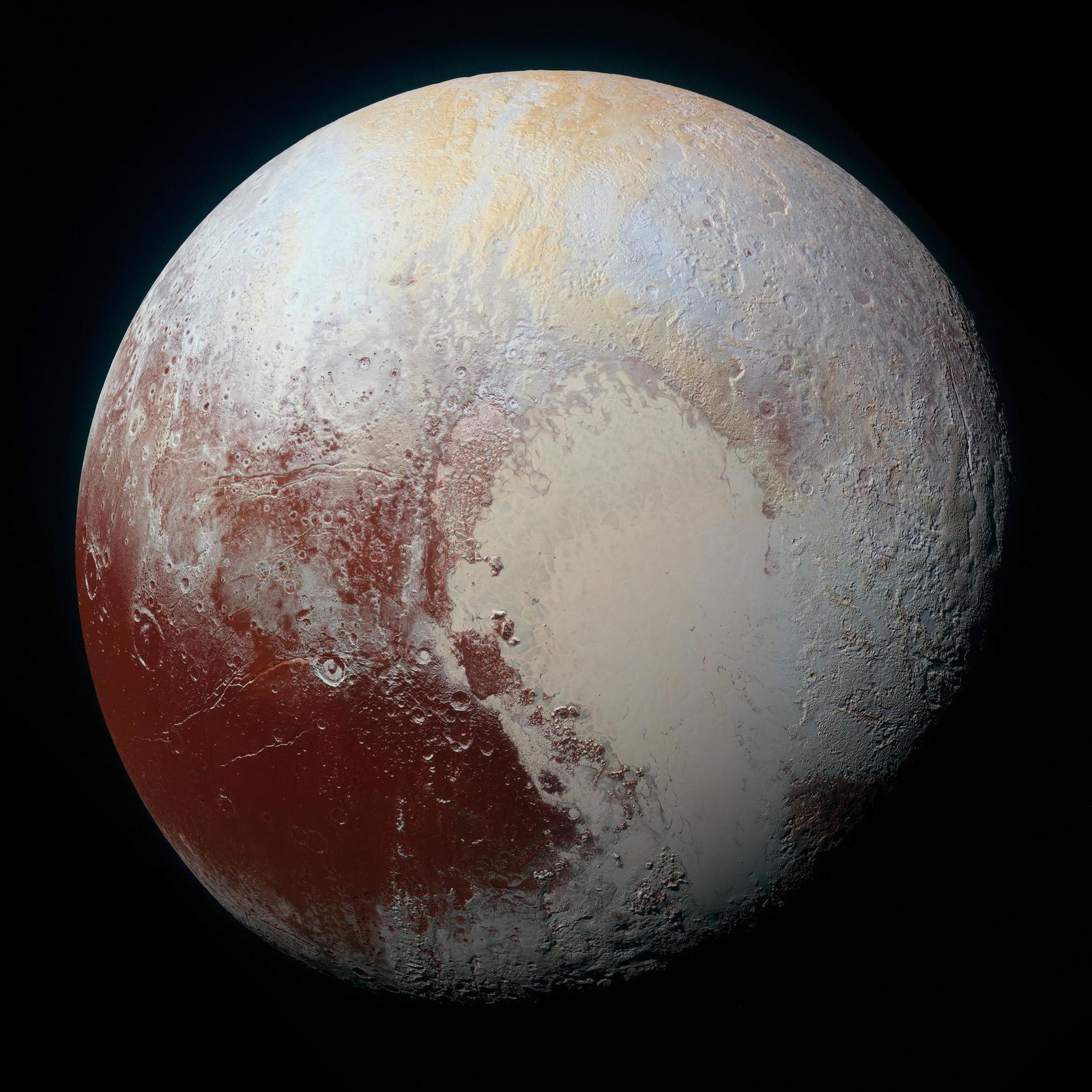
Pluto's rich colors from New Horizons: NASA/Johns Hopkins University Applied Physics Laboratory/Southwest Research Institute, Public domain
From ninth planet to dwarf planet
Clyde Tombaugh discovered Pluto in 1930 at Lowell Observatory in Arizona by comparing photographs of the night sky and spotting a faint dot that moved. For 76 years it was counted as the ninth planet.
Then astronomers began finding many similar icy bodies beyond Neptune in a region called the Kuiper Belt, including Eris, which is nearly the same size. In 2006, the International Astronomical Union created the category of dwarf planet, and Pluto became its most famous member. It is smaller than our Moon, but it is a far more complex world than anyone expected.
Video: A Close Look At Pluto. Credit: NASA/Johns Hopkins University Applied Physics Laboratory/Southwest Research Institute; NASA's Goddard Space Flight Center (source). NASA media; no endorsement implied.
A heart made of ice
In July 2015, NASA's New Horizons spacecraft raced past Pluto after a journey of more than nine years and about 5 billion km. Its photos revealed a giant, bright heart-shaped region. The western lobe, named Sputnik Planitia, is a vast basin about 1,000 km across filled with frozen nitrogen that slowly churns like a lava lamp, constantly renewing its surface.
Around it rise mountains of water ice, some several kilometers tall. On Pluto, water ice is as hard as rock, so it forms the planet's bedrock while softer nitrogen and methane ices flow across it.
New Horizons flew within about 12,500 km of Pluto's surface, close enough to spot features the size of city blocks in its sharpest images. Because it was moving so fast and had so much data to send across billions of kilometers, it took more than a year to beam all of its flyby observations back to Earth.
Blue skies and a hidden ocean
Pluto has a thin nitrogen atmosphere layered with haze. When New Horizons looked back at Pluto with the Sun behind it, the haze glowed blue, a surprising sight on a reddish world so far from the Sun.
Several clues suggest Pluto may have a liquid water ocean beneath its icy shell, possibly kept from freezing by heat from its interior and an insulating layer of gas. If so, this small, distant world joins the list of places in the solar system with hidden oceans.
A double world in the deep cold
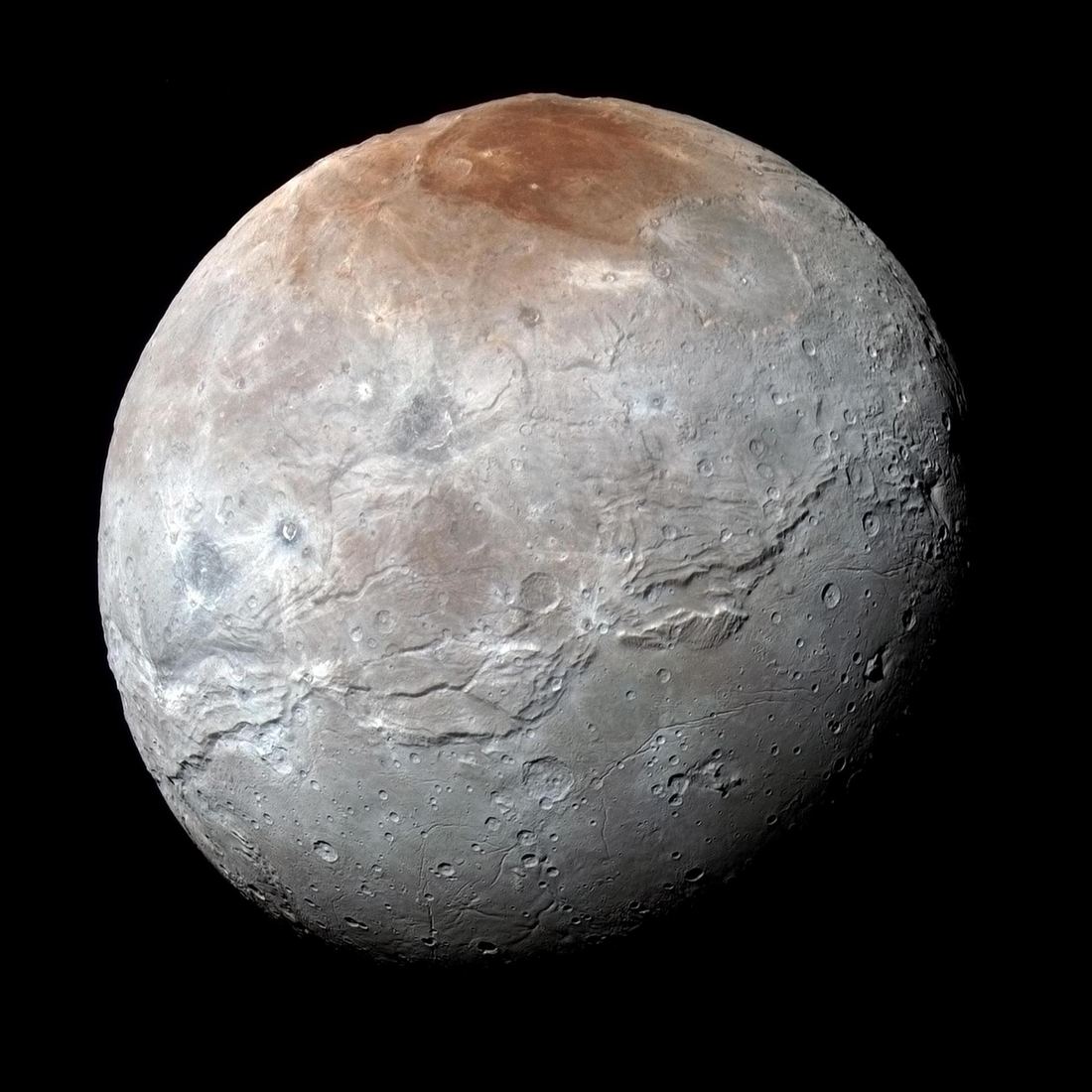
Pluto's largest moon, Charon, is about half its width, so large that the two orbit a point in space between them. They are locked face to face, each always showing the same side to the other. Four smaller moons, Nix, Hydra, Kerberos and Styx, circle the pair.
Sunlight at Pluto is hundreds of times dimmer than at Earth, and surface temperatures hover around -230 °C. A single Pluto year lasts 248 Earth years, so it has not yet completed one orbit since its discovery.
After Pluto, New Horizons kept going deeper into the Kuiper Belt. On January 1, 2019, it flew past Arrokoth, a small, reddish snowman-shaped body that is the most distant object ever explored up close, offering a glimpse of the building blocks left over from the birth of the planets.

Facts on this page were checked against these sources.
- Pluto's rich colors from New Horizons: NASA/Johns Hopkins University Applied Physics Laboratory/Southwest Research Institute, Public domain
- Pluto's blue haze in a farewell view from New Horizons: NASA/Johns Hopkins University Applied Physics Laboratory/Southwest Research Institute, Public domain
- Charon in enhanced color: NASA/Johns Hopkins University Applied Physics Laboratory/Southwest Research Institute, Public domain
- Video: A Close Look At Pluto, NASA/Johns Hopkins University Applied Physics Laboratory/Southwest Research Institute; NASA's Goddard Space Flight Center, NASA (public domain)
Text written by Planetinio.